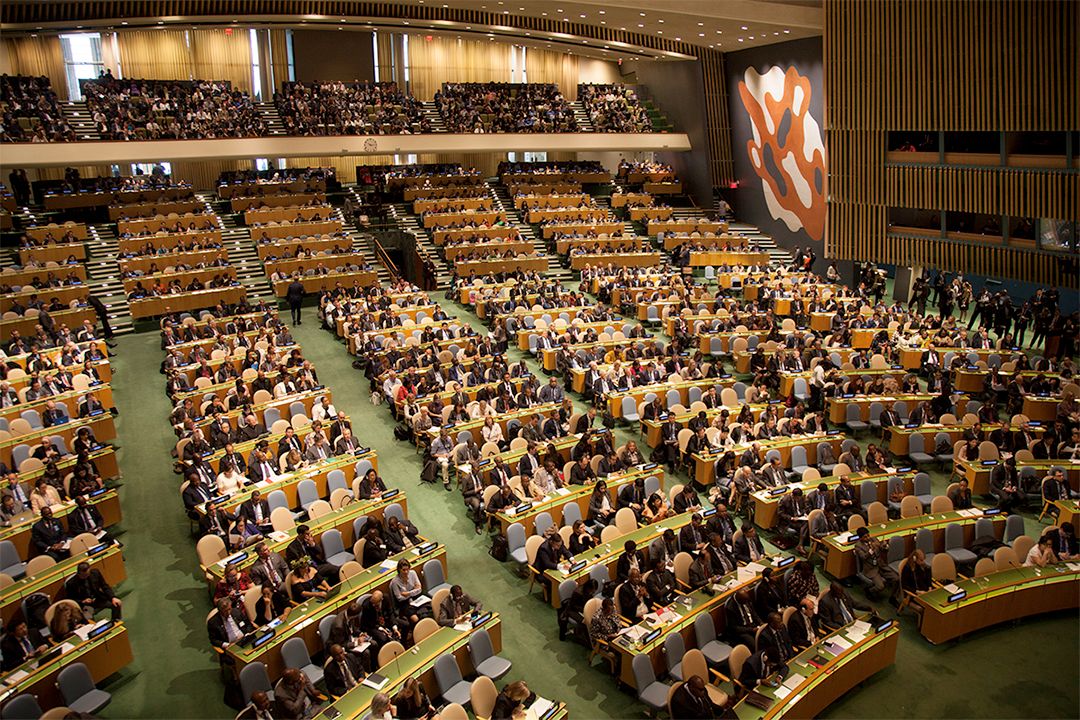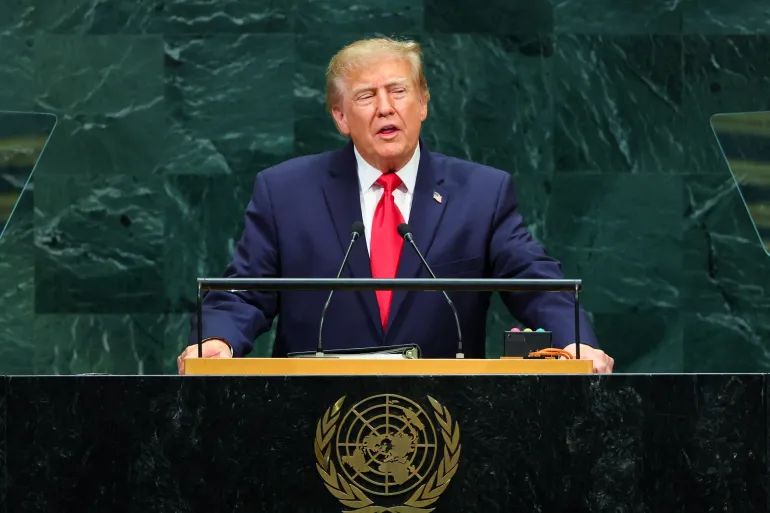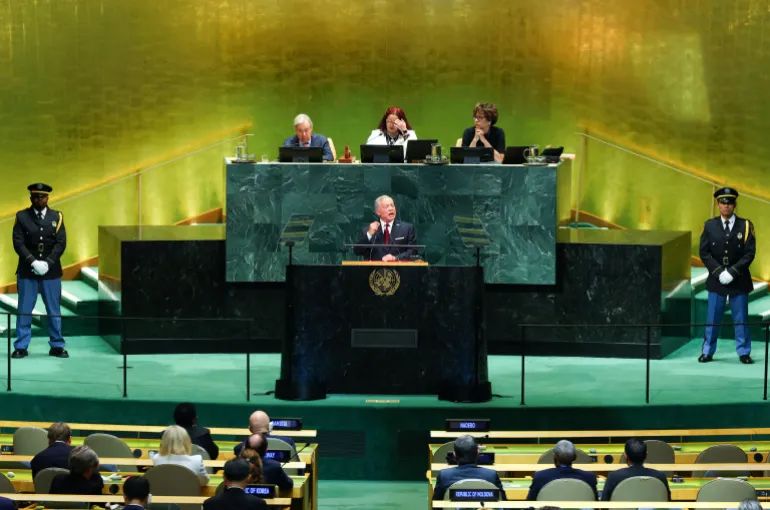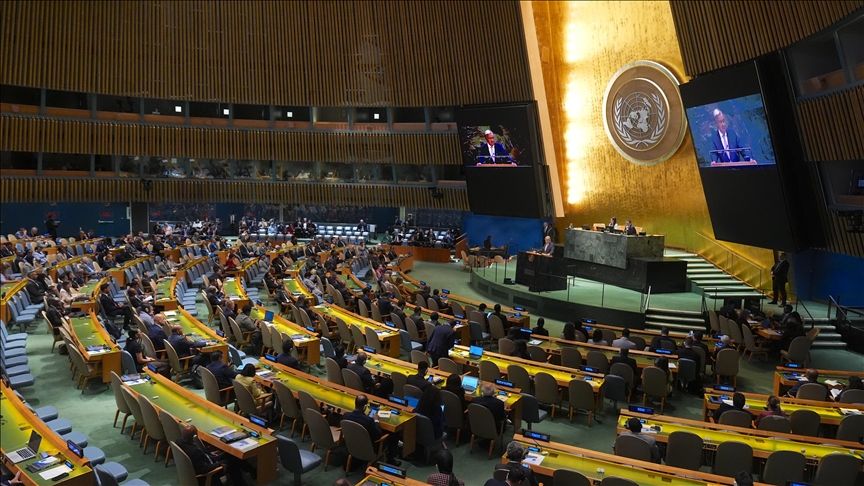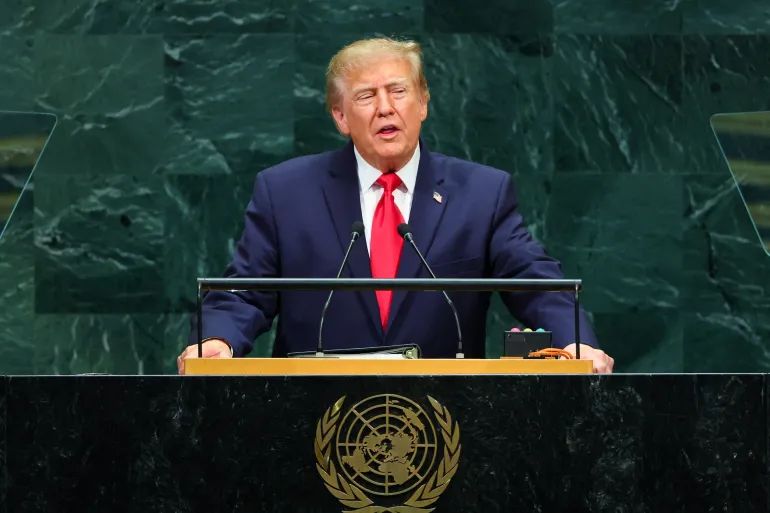

US President Donald Trump has concluded his address to the 81st session of the United Nations General Assembly in New York, using the speech to outline his administration’s positions on Gaza, Iran, Ukraine, Venezuela, immigration, artificial intelligence, the United Nations and US military power.
In his closing remarks, Trump urged countries to reject what he described as fear and doubt and to unite against what he called “the enemies of all humanity.”
“If we reject the voices who would have us give in to fear and doubt, if we refuse to shrink from our duties to our people, then together, through bold action, we will make this world far safer and a far better place,” Trump said.
Gaza and the hostages
A significant portion of Trump’s remarks focused on the war in Gaza. He said that when he previously addressed the UN General Assembly, the conflict was still continuing and hostages were being held in Hamas tunnels.
Trump claimed that his administration had subsequently taken steps that changed the situation and said the war had ended weeks later, describing this as having saved “untold thousands of lives.”
He also said that all remaining hostages had been brought home, including those who were dead, a statement that was met with applause in the General Assembly.
Trump threatens ‘annihilation’ of Iran while predicting a future deal
Trump issued some of his strongest remarks against Iran during the address, presenting Tehran with what he described as a choice between reaching an agreement and facing devastating consequences.
He asked whether a deal could allow Iran to rebuild and become “a far better country” or whether the United States should “annihilate the Islamic Republic.”
Trump said he nevertheless believed a settlement could eventually be reached after the US midterm elections. He argued that Iran was waiting to see the outcome of the November election, while noting that he himself would not be on the ballot.
He separately called on countries around the world to join Washington in economically isolating Iran.
Trump said Iran should remain isolated until it stops attacks on commercial shipping, abandons what he described as its nuclear ambitions and ends its support for groups he characterised as terrorist organisations.
He also claimed that US military action had helped move more than one billion barrels of oil through the Strait of Hormuz during the conflict.
Trump reiterated that the United States would not allow Iran to obtain a nuclear weapon, while accusing the Iranian government of decades of bloodshed and destabilisation across the Middle East. He said that after taking office he had offered Tehran economic cooperation in exchange for ending its nuclear programme and support for terrorism, but claimed Iran rejected the proposal.
Ukraine war
Trump also addressed Russia’s war in Ukraine, saying he believed the conflict could be resolved “more quickly than people understand.”
He said his administration was working with both Russian and Ukrainian leaders and expressed confidence that an agreement could eventually be reached. The comments offered little additional detail in the excerpts provided about the terms of a potential settlement.
Reasserting US military power
Trump presented military strength as a central element of his foreign-policy approach.
He said the United States was “reasserting American power,” including military power, both in its own region and internationally. He argued that such action was necessary to create what he described as a safer future.
Trump also said the US had invested more money in its military during the previous 12 months than ever before and said spending during his current term would reach $1.5 trillion.
He contrasted his approach with leaders who, in his characterization, had spoken about peace without taking action, saying that his administration had acted when necessary.
Venezuela and a major oil claim
Trump said the United States and Venezuela had reached what he described as the largest oil deal in history, involving 65 billion barrels of oil.
According to Trump, the agreement would benefit both countries and help reduce energy costs globally. He also said major international oil companies were entering Venezuela.
Trump further claimed that the United States and Venezuela together account for more than 60 percent of the world’s oil.
These figures were presented as claims by the US president in his UN address; the supplied source does not provide independent verification of them.
Cuba
Trump also delivered a stark assessment of Cuba, saying his administration was seeking “a fundamental change” in the situation there.
He described Cuba as a failed state and predicted that its communist government would fall.
“Communism will never be coming to America, but freedom will be coming to Cuba,” Trump said.
The Cuban delegation walked out of the General Assembly chamber while Trump was making those remarks.
Criticism of the International Criminal Court
Trump strongly criticised the International Criminal Court, calling it an “out-of-control” and “rogue” institution.
He said the United States did not recognise the court’s authority over US personnel and argued that American service members should not be subjected to investigations or trials by what he described as an anti-American tribunal.
Trump went further by urging ICC member states to leave the institution.
Dispute over UN budget and global governance
Trump also used the speech to discuss the United Nations itself.
He claimed that the United States had worked with other countries to implement major UN reforms and said the UN budget had been reduced by 15 percent in 2026, resulting, according to his statement, in more than 4,000 positions being eliminated.
He criticised what he described as a “far-left agenda” promoted by international bureaucrats and argued that there should be no global government or global taxes.
Trump also said his administration had stopped what he described as an effort by the International Maritime Organization to establish a global carbon tax that he claimed could increase international shipping costs by 10 to 20 percent or more.
Greenland and US military presence
Trump announced what he described as an “unprecedented agreement” concerning Greenland.
According to Trump, the agreement with Denmark and Greenland would allow the United States to develop a major military presence there, including two military bases.
He said the proposed presence would help protect North America and Europe while strengthening NATO.
AI: Trump rejects calls to rein in development
Artificial intelligence was another major subject.
Trump said the United States rejected what he called a “globalist scheme” to control what he termed “super intelligence.”
He argued against restricting the development of AI and said the US would encourage the technology while seeking to develop it safely and responsibly.
Trump also suggested that US government documents would replace the term “artificial intelligence” with “super intelligence,” which he abbreviated as “SI.”
Immigration and US border security
On domestic policy, Trump highlighted his administration’s immigration enforcement efforts.
He claimed that the United States now had the “most secure border in American history” and said that people could not enter the country unless they were invited.
He presented the crackdown on undocumented immigration as one of the major accomplishments of his second term.
Closing message
Trump ended his UN address by calling for countries to act collectively against what he described as threats facing humanity.
His speech brought together several major themes of his administration’s foreign and domestic policy: military strength, opposition to Iran’s nuclear programme, support for US economic and strategic interests, pressure on international institutions, restrictions on irregular immigration, technological expansion and his administration’s claims regarding the end of the Gaza war.
The address was delivered as wars and major geopolitical disputes continued to dominate the international agenda, including conflicts involving Gaza, Iran and Ukraine.