
King Abdullah says forced displacement of Palestinians in West Bank is ‘war crime’
# Israel# PalestineJordan’s King Abdullah II has warned the international community that developments in the occupied West Bank represent a “fundamental shift” in Israel’s policies toward Palestinians, accusing Israel of pursuing measures aimed at forcing Palestinians from their land.
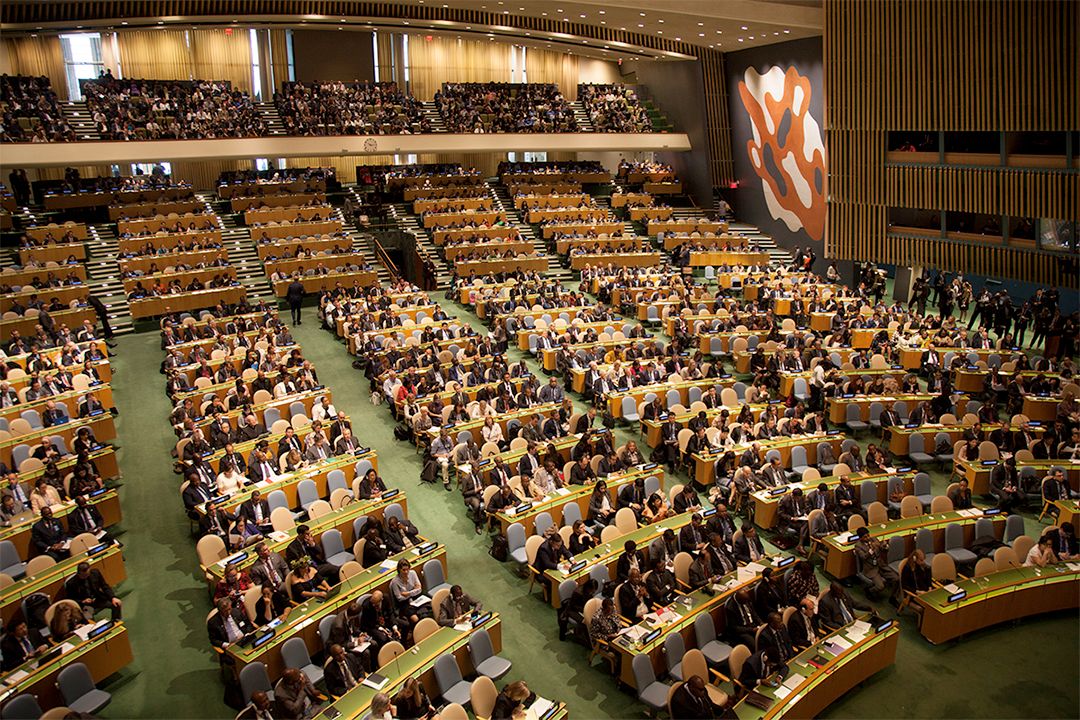
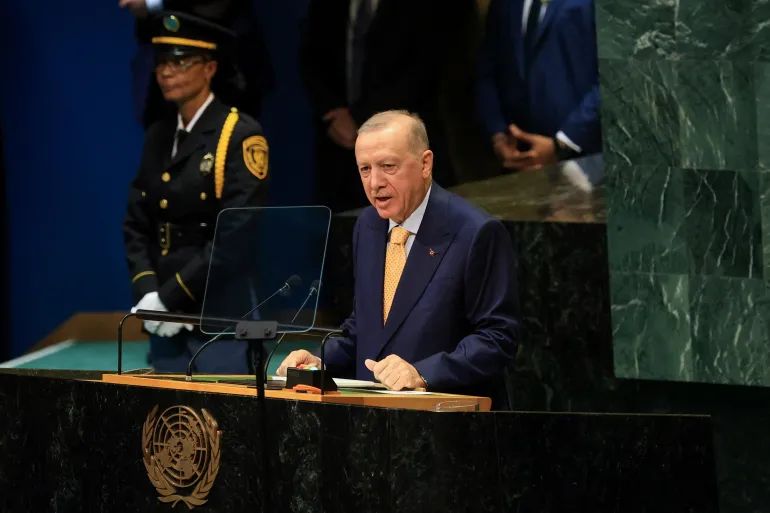
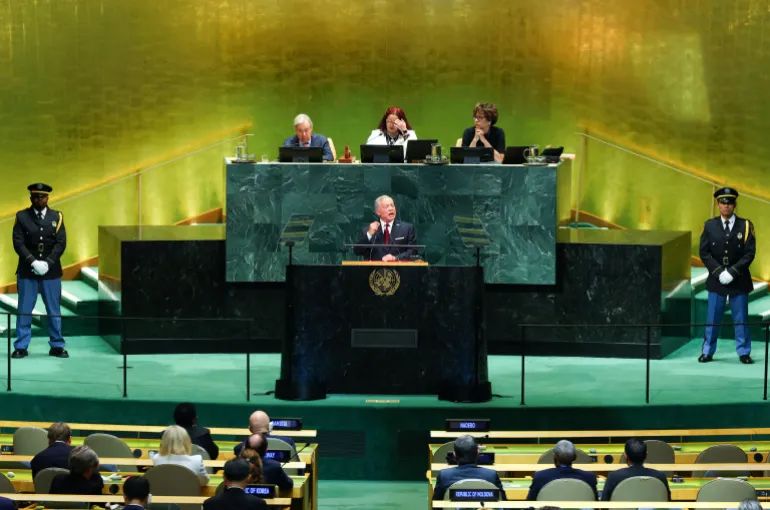
Addressing the United Nations General Assembly, King Abdullah said the international community’s focus on the war in Gaza had allowed what he described as an increasingly dangerous situation in the West Bank to develop with insufficient international attention.
He argued that the developments were not simply a continuation of previous patterns of settlement expansion, violence and displacement, but represented what he described as a coordinated policy.
“Some may think we have seen this before — settlements, violence, displacement, more of the same. But it is not. Nor is it simply an escalation. This is a fundamental shift,” he said.
Accuses Israel of pursuing forced displacement
King Abdullah said the developments taking place throughout the occupied West Bank should not be viewed as isolated incidents.
According to the Jordanian monarch, they form part of what he described as a broader policy intended to pressure Palestinians into leaving their homes and land.
“These are not a series of isolated acts,” King Abdullah said. Rather, he argued, they are “elements of a single policy to compel an entire population to leave their land.”
“There is a name for that: forced displacement. And that is a war crime,” he added.
His comments come amid continued international concern over Israeli settlement activity, land seizures, violence and displacement in the occupied West Bank, alongside the ongoing humanitarian crisis in Gaza.
Raises questions over international law
The Jordanian king also questioned the effectiveness of the international legal system and the international community’s ability to enforce its own rules.
He described the occupation of Palestinian territories as one of the longest-running occupations in the world and asked what international law means if violations are not effectively addressed.
“What exactly is [international] law worth, and how can we enforce it if we won’t even call out its violations?” he asked the General Assembly.
King Abdullah said he had repeatedly warned world leaders about the consequences of allowing the Israeli-Palestinian conflict to remain unresolved.
“For decades, I stood before this assembly and warned of the dangers of leaving the Palestinian-Israeli conflict unresolved,” he said.
“But the international community chose to manage the conflict, not confront it.”
According to King Abdullah, repeated Israeli actions that were initially regarded internationally as temporary have gradually become entrenched.
“Every new Israeli violation was treated as temporary,” he said. “Until temporary became permanent, and permanent became policy.”
He further argued that preventing the establishment of a Palestinian state has increasingly become an established Israeli policy.
Gaza and West Bank are “two fronts of the same strategy”
King Abdullah also rejected the idea that Gaza and the West Bank should be treated as two separate political and humanitarian issues.
“The first is that Gaza and the West Bank are separate stories. They are not,” he said.
“They are two fronts of the same Israeli strategy. In both, Palestinians are being killed.”
He also criticized the treatment of Palestinians in Gaza, arguing that the concentration of Palestinians into a limited part of the territory could no longer be explained simply as a temporary consequence of military operations.
King Abdullah said that squeezing Palestinians into a third of Gaza could not be dismissed as a temporary military measure or merely as a consequence of the war.
“Accountability begins when we call things for what they are: an attempt to erase Palestinian life and impose a new territorial reality in Gaza,” he said.
Raises concerns over casualties and Jordanian field hospitals
Addressing the humanitarian situation in Gaza, King Abdullah cited Palestinian child deaths and referred to attacks affecting Jordanian medical facilities operating in the territory.
He said that, according to figures he cited, at least 300 Palestinian children had been killed during the first 300 days of what he referred to as the “so-called ceasefire.”
“Jordan’s field hospitals have also been targeted,” he said.
The king used the situation to argue that the humanitarian consequences of the conflict extend beyond the immediate battlefield and affect medical personnel, humanitarian operations and civilians.
Warns of a growing sense of impunity
King Abdullah also criticized what he described as the international community’s limited enforcement of measures against Israel.
He noted that sanctions, diplomatic isolation and asset freezes have been used against other countries in different circumstances, but argued that similar international measures concerning Israel have frequently failed to produce meaningful consequences.
“With Israel, resolutions end where they began: on paper,” he said.
The Jordanian king described this as a deliberate choice that has contributed to what he called a “state without restraint.”
“This sense of impunity has reached terrifying levels,” he said.
He also warned the international community against assuming that the consequences of the current situation would remain confined to the Palestinian territories.
“No one in this assembly should assume its ambitions stop at Palestine,” he said.
Warns about Syria
King Abdullah also referred to Syria, describing developments there as a warning that the international community should not ignore.
“Today Syria is the warning the international community is choosing not to see,” he said.
His remarks linked the Palestinian issue with broader regional instability and the potential consequences of continued conflict and unresolved territorial disputes across the Middle East.
Says Palestinian statehood is being rejected
The Jordanian king also addressed the future of Palestinian statehood, arguing that Israel's rejection of an independent Palestinian state has become increasingly entrenched.
He said it was clear to him that Israel would not change its position on Palestinian statehood.
“It is not. It is cemented on the ground,” he said.
King Abdullah pointed to the expansion of Israeli settlements and land seizures, arguing that the changes had taken place gradually over decades.
“This government has been accelerating settlements and land seizures, but it began long before. Since Oslo, the map has changed piece by piece, settlement by settlement,” he said.
Defends Arab peace efforts
King Abdullah also rejected what he described as a “dangerous illusion” that Arab countries had never seriously sought peace with Israel.
He pointed to the 2002 Arab Peace Initiative, which proposed normalization between Israel and Arab states in exchange for a comprehensive peace and the establishment of a Palestinian state.
“The Arab Peace Initiative of 2002 offered Israel normalisation with 57 Arab and Muslim states including Iran and Iraq at the time in exchange for peace and Palestinian statehood,” he said.
According to the king, the proposal has remained available for more than two decades.
“For over 20 years, that offer has stood,” he said.
He argued that the central obstacle was not the absence of an Arab partner willing to pursue peace, but what he described as the lack of an Israeli government prepared to accept the proposed terms.
“The obstacle hasn’t been the absence of a partner for peace, but the absence of an Israeli government willing to accept it,” King Abdullah said.
Call for a change in international approach
King Abdullah's address ultimately called for a fundamental change in how the international community approaches the Israeli-Palestinian conflict.
Rather than continuing to manage successive crises, he argued that international actors must address what he described as the underlying political and territorial issues, including the occupation, settlement expansion, displacement, Palestinian statehood and accountability under international law.
His speech placed the humanitarian crisis in Gaza and developments in the West Bank within what he described as a single broader conflict, while warning that continued international inaction could further undermine the rules-based international system and contribute to wider instability in the Middle East.