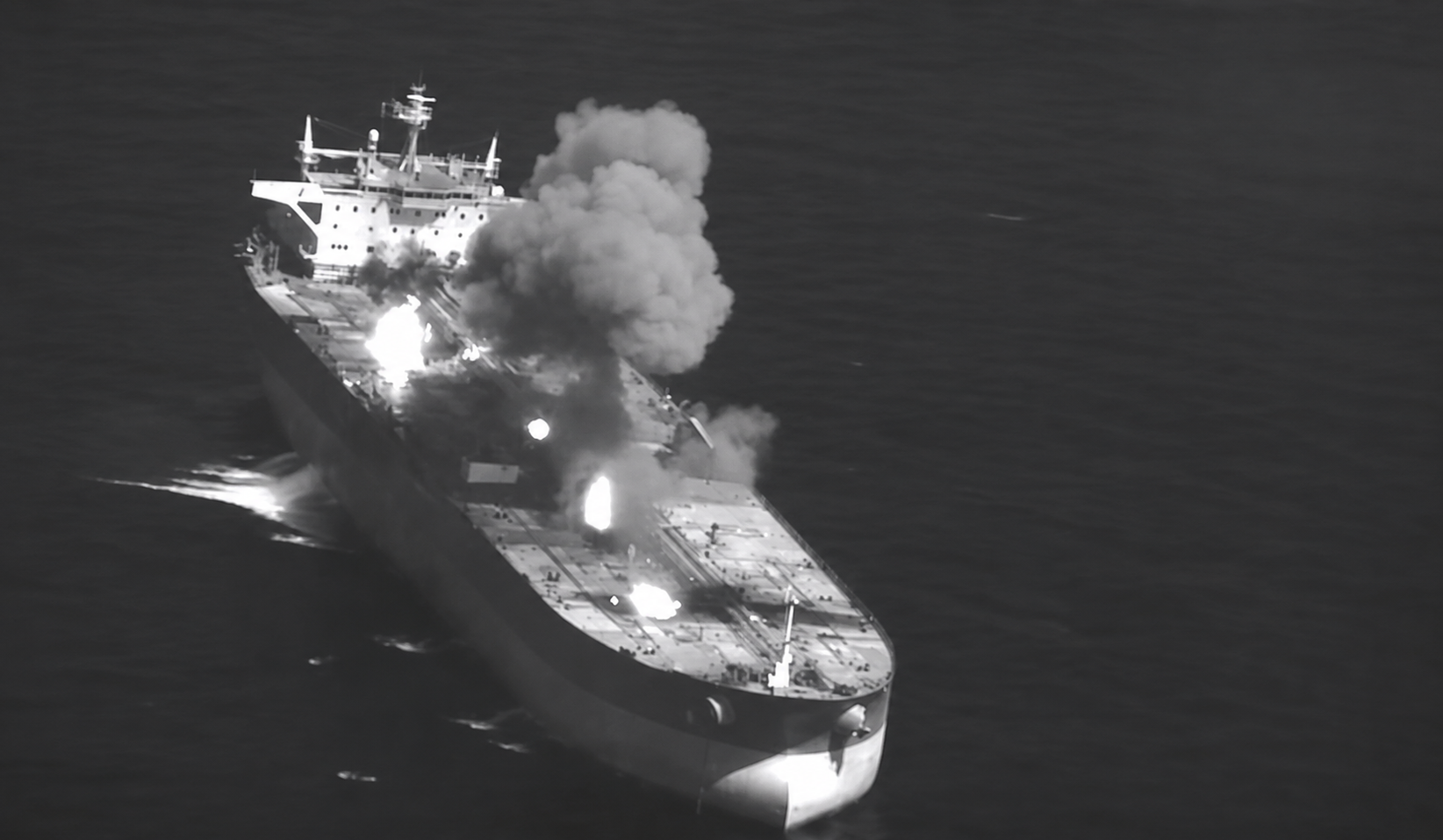

The United States has struck three Iranian crude-oil carriers after Iran’s Islamic Revolutionary Guard Corps (IRGC) launched ballistic missiles toward two US Navy warships patrolling regional waters, according to US Central Command (CENTCOM), marking a fresh escalation in the increasingly prolonged US-Iran conflict.
WASHINGTON/TEHRAN — September 5, 2026: The United States has struck three Iranian crude-oil carriers after Iran’s Islamic Revolutionary Guard Corps (IRGC) launched ballistic missiles toward two US Navy warships patrolling regional waters, according to US Central Command (CENTCOM), marking a fresh escalation in the increasingly prolonged US-Iran conflict.
CENTCOM said its forces carried out the attacks on September 5, targeting Iranian oil carriers that Washington says are connected to the IRGC and contribute to the financing of Iran’s regional armed groups. The US military said the strikes came after the Iranian missile launches against American naval vessels.
According to the US military, the American ships were able to evade the Iranian attacks and there were no reported US personnel casualties from the missile launches. The strikes on the tankers represent a further expansion of the conflict from conventional military targets to Iran’s oil-export infrastructure and maritime economy.
Iranian tanker reportedly hit near Kharg Island
Iranian media had earlier reported that an Iranian oil tanker was hit by several US missiles off Kharg Island, one of Iran’s most important oil-export hubs.
US strikes were reported against three crude carriers, with the attacks occurring in waters near Iran’s coast and around the Gulf of Oman. The location of the Kharg Island strike is particularly significant because of the island’s central role in Iran’s oil-export network.
The Associated Press reported that two of the tankers were permanently disabled while another was destroyed. Iranian state media reported missile impacts and evacuations of crew members, although Tehran had not issued a comprehensive official response to the US claims at the time of reporting.
The US administration has characterized the targeted vessels as part of a maritime network that helps generate revenue for the IRGC and Iran-linked regional forces.
Missile exchange raises risks in Gulf waters
The latest confrontation comes amid an already volatile maritime environment surrounding Iran, the Persian Gulf and the Strait of Hormuz.
The waterway is one of the world's most important energy corridors, and the escalation involving Iranian and American military forces raises concerns over further disruption to commercial shipping and global energy markets.
The United States has repeatedly warned that attacks against its military forces in the region will draw a military response. Iran, meanwhile, has continued to portray the American campaign as an attempt to weaken the Islamic Republic militarily and economically.
The latest tanker strikes demonstrate how quickly attacks on military vessels can spill into economic and energy targets.
Trump renews threat against Pickaxe Mountain
The tanker strikes came as US President Donald Trump again threatened to attack Iran's heavily fortified Pickaxe Mountain facility.
Trump said the United States could strike the site “very soon”, renewing a threat he first made in July. Pickaxe Mountain is considered a heavily protected part of Iran's nuclear infrastructure and is located near the damaged Natanz enrichment complex. Reuters reported that the facility contains deeply buried tunnel complexes, making it a difficult target.
Trump has simultaneously sought to downplay the scale of the conflict, describing the lengthy confrontation as “small potatoes”, even as the fighting continues to generate casualties and threaten regional stability.
A strike on Pickaxe Mountain would represent a potentially significant new stage of the conflict because of the site's association with Iran's nuclear infrastructure and its fortified underground facilities.
Tehran accuses Washington of shifting to economic warfare
Iran's First Vice President Mohammad Reza Aref said Washington had turned increasingly toward economic pressure after failing to achieve its objectives through military action.
Aref has argued that the conflict has forced Tehran to reassess its defence strategy and prepare for what he described as a prolonged confrontation. Iranian officials have increasingly emphasized the economic consequences of the war for the United States and its allies, particularly through energy markets and maritime trade.
Iranian officials have also warned that future responses to US attacks could be asymmetric and designed to impose costs beyond the immediate battlefield.
The latest attacks on Iranian oil carriers could therefore deepen the economic dimension of the conflict, with both sides increasingly targeting or threatening the other's ability to sustain military operations and economic activity.
Pentagon launches extraordinary leak investigation
Meanwhile, the conflict is generating political pressure inside Washington as the Pentagon investigates leaks concerning the US military's weapons stockpiles and its ability to sustain the Iran campaign.
US government investigators have administered polygraph tests to approximately 50 members of the Joint Staff, according to reports by The New York Times and CBS News.
The investigation reportedly focuses on leaks concerning shortages of sophisticated US munitions, including long-range missiles and Patriot interceptors, amid the rapid expenditure of weapons during the war.
CBS reported that several dozen officials were subjected to the tests, including personnel associated with US Central Command and other combatant commands. The unusually broad use of polygraph testing reflects the seriousness with which Pentagon officials are treating the disclosures.
According to CBS, none of the officials tested failed questions specifically aimed at determining whether they had leaked information to the media. Chairman of the Joint Chiefs of Staff Gen. Dan Caine was reportedly not among those subjected to the tests.
The leaks have reportedly angered Trump, who has rejected claims that the US military is facing serious strategic weapons shortages and has described some of the disclosures as false or “treasonous”.
The investigation comes as questions grow over the long-term sustainability of the US military campaign. Reports about weapons consumption have raised concerns about the ability of Washington to maintain the Iran operation while preserving sufficient stocks for other potential global contingencies.
US envoy addresses West Bank violence
Away from the Iran front, the wider regional crisis was also reflected in the occupied West Bank, where US Ambassador to Israel Mike Huckabee called on the Israeli government to guarantee the safety and security of the population.
Huckabee visited Palestinian families affected by settler violence and condemned attacks by Israeli settlers, describing some of the actions as terrorism. He said Israel has a responsibility to protect people living in the West Bank.
His comments come amid heightened international scrutiny of settler attacks against Palestinians, including allegations of arson, property destruction and assaults.
The ambassador's remarks mark a notable public call from a senior Trump administration official for Israeli authorities to address violence against Palestinians, even as Washington remains closely aligned with Israel on the broader regional confrontation with Iran.
Conflict enters another dangerous phase
The US strikes on Iranian oil carriers, Iran's ballistic missile launches against American warships and Trump's renewed threat against Pickaxe Mountain indicate that the conflict is continuing to expand across military, economic and strategic fronts.
What began as a confrontation centred heavily on military and nuclear targets is increasingly affecting oil infrastructure, commercial shipping, weapons stockpiles and regional security.
The attacks also carry implications far beyond Washington and Tehran. Any sustained disruption to Iranian oil exports or shipping through the Persian Gulf could place additional pressure on global energy markets, while further attacks against US naval forces could trigger another round of American strikes.
With neither side showing signs of abandoning its core objectives, Saturday's tanker strikes could prove to be another significant escalation in a conflict whose consequences are increasingly being felt across the wider Middle East.






-Getty-Images_CNT-UK_Sophie-Knight.jpeg?w=3840&q=75)