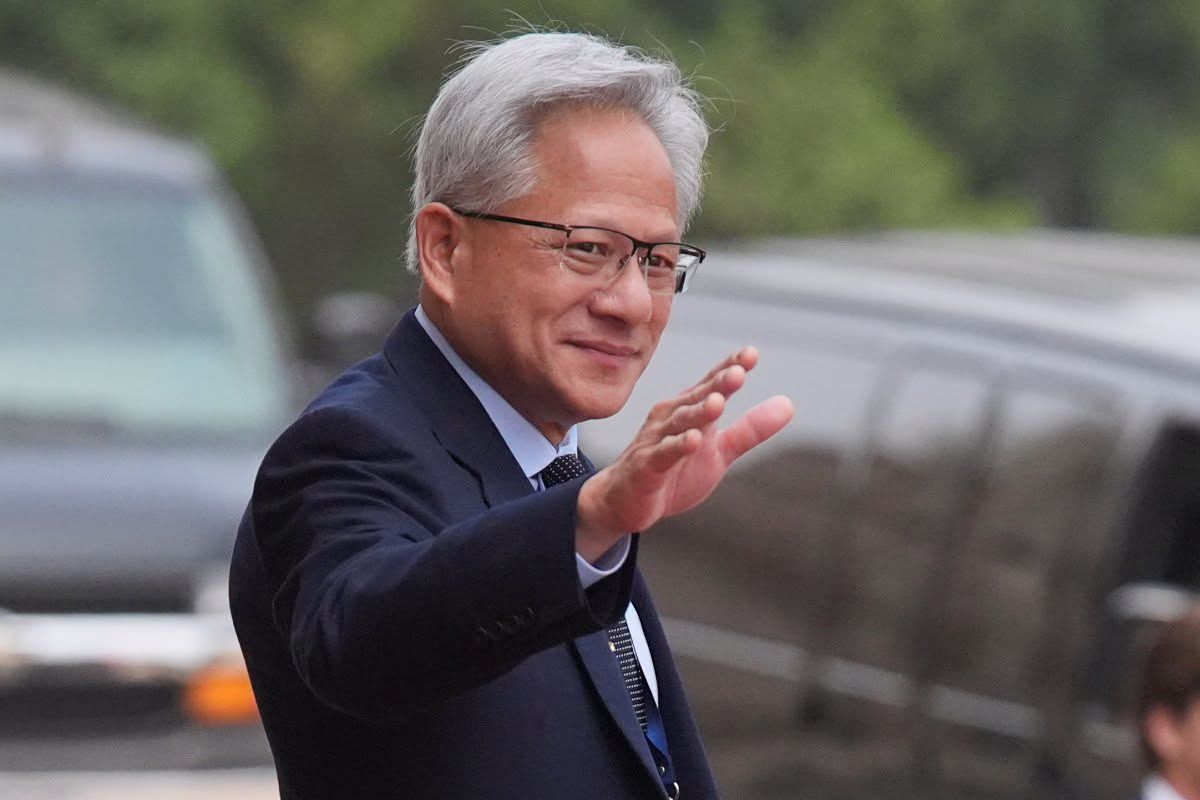

Nvidia founder and Chief Executive Officer Jensen Huang continues to lead the American technology giant as the company strengthens its position at the centre of the global artificial intelligence industry.
Huang, who co-founded Nvidia in 1993, has remained one of the most influential figures in the technology sector, overseeing the company's transformation from a graphics chip manufacturer into a major supplier of the computing technology powering modern artificial intelligence systems.
Under his leadership, Nvidia has expanded far beyond its original focus on graphics processing units used in gaming computers. Its technology now plays a central role in data centres, scientific research, autonomous vehicles and the development of increasingly sophisticated AI models.
The rapid adoption of artificial intelligence has significantly increased demand for Nvidia's advanced processors, particularly among major technology companies investing billions of dollars in AI infrastructure.
Companies developing generative AI systems rely heavily on powerful computing hardware to train and operate their models, placing Nvidia in a particularly influential position within the global technology market.
Huang has played a central role in shaping the company's long-term strategy, consistently investing in accelerated computing and software development years before artificial intelligence became a major commercial priority.
One of Nvidia's most important advantages has been its CUDA computing platform, which allows developers to use Nvidia graphics processors for a wide range of complex computing tasks. The platform has helped establish a substantial software ecosystem around the company's hardware.
Despite its strong market position, Nvidia continues to face challenges, including increasing competition from rival chipmakers, growing efforts by major technology companies to develop their own AI processors, and restrictions affecting the international semiconductor trade.
The company also operates in an industry where technological advances happen rapidly, requiring substantial investment in research, development and new computing architectures.
Huang's leadership has become closely associated with Nvidia's ability to anticipate major changes in computing technology and turn those developments into commercial opportunities.
Born in Taiwan, Huang moved to the United States during his childhood and later studied electrical engineering. He co-founded Nvidia alongside Chris Malachowsky and Curtis Priem, initially focusing on graphics technology at a time when the market for advanced computer graphics was still developing.
Over the following decades, Nvidia's graphics processors became widely used in gaming before researchers discovered their potential for accelerating the complex calculations required in artificial intelligence.
That shift ultimately helped establish Nvidia as a central player in the AI industry.
As governments and businesses continue expanding investments in artificial intelligence, Nvidia's future performance will depend on its ability to maintain its technological advantage, meet growing demand and navigate an increasingly competitive international market.
Huang remains central to those efforts, with his leadership continuing to shape Nvidia's direction and its role in the development of next-generation computing technology.